Japanese Works of Art


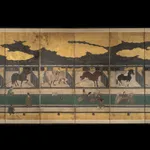
A PAIR OF SIX-FOLD BYŌBU (SCREENS) DEPICTING THE HORSE STABLE
W: 360cm
Further images
-
(View a larger image of thumbnail 1
)

-
(View a larger image of thumbnail 2
)
-
(View a larger image of thumbnail 3
)

-
(View a larger image of thumbnail 4
)

-
(View a larger image of thumbnail 5
)

-
(View a larger image of thumbnail 6
)

-
(View a larger image of thumbnail 7
)

-
(View a larger image of thumbnail 8
)

-
(View a larger image of thumbnail 9
)
-
(View a larger image of thumbnail 10
)

-
(View a larger image of thumbnail 11
)

Provenance
On loan to the Art Institute of Chicago, September 1989 - September 1991
Private Collection: Europe
Exhibitions
Art Institute of Chicago, September 1989 - September 1991
Literature
COMPARE:
Cleveland Museum of Art, Cleveland, Ohio, USA (1934.373), a nearly identical pair on which which the present screens were based
Tokyo National Museum, Tokyo, Japan (A-10139)
Imperial Household Agency, Tokyo, illus. Screen Paintings of the Muromachi Period: Kokka 100th Anniversary Exhibition (1989), cat. no. 35, pp. 106-7
SEE ALSO:
A pair of 17th Century screens sold Christie’s, 18 Sept 2008, USD 962,500
A pair of early 17th Century screens sold Christie’s, 28 March 2006, USD 968,000
A single late 16th early 17th Century sold Sotheby’s, 25 October 2023, GBP 482,600
A SUPERB AND RARE PAIR OF SIX-FOLD BYŌBU (SCREENS) DEPICTING A HORSE STABLE
Japan, Momoyama to Early Edo period, circa 1600
Among the rarest surviving examples of Japanese genre painting from the Momoyama period, this magnificent pair of six-fold byōbu presents an unusually complete and sophisticated portrayal of an aristocratic horse stable. Comparable examples are confined to only a handful of important collections, notably the Cleveland Museum of Art, the Tokyo National Museum, and the Imperial Household Agency, while the present pair was exhibited on loan to the Art Institute of Chicago between 1989 and 1991, testament to both their rarity and scholarly importance.
Far more than simple depictions of horses, the screens provide a vivid account of elite samurai life at the turn of the seventeenth century. Here the stable is presented not merely as a functional building but as the ceremonial and social heart of the residence, where military prestige, hospitality, recreation and religious belief converged. Unlike European houses of the period, where stables were hidden behind the principal residence, the Japanese stable occupied a position of honour at the entrance to the estate, announcing both the wealth and martial status of its owner.
The Portuguese missionary Luis Fróis, writing in Striking Contrasts in the Customs of Europe and Japan in 1585, remarked upon this striking difference:
*“In the homes of European nobility guests are first welcomed in the living quarters; in Japan their first reception takes place in the stables… Our stables are always behind or in the lower part of the house; in Japan, they are built at the front of the house.”*¹
Another early Western visitor similarly expressed astonishment at their refinement:
*“There was a stable above, wherein there were no more than five or six horses; but it was a stable only in name, because it was so clean and well kept that it seemed rather to be a fine chamber for the diversion of nobles than a place to lodge horses.”*²
Constructed from sugi (Japanese cedar), the sacred timber associated with Shinto shrines and Buddhist temples, these buildings reflected the revered status of the horse within Japanese culture. Horses were regarded as sacred beings, capable of carrying divine messages and mediating between the earthly and spiritual worlds. Their importance extended well beyond warfare, occupying a central place in ceremony, pilgrimage and court ritual.
The artist has populated the stable with an extraordinary cast of horses, each rendered with remarkable individuality. Rather than serving as decorative motifs, they appear almost as portraits, every animal possessing its own distinct temperament and physical presence. Some rear impatiently against their tethers, others toss their heads or stamp the ground, while several stand quietly alert or feed peacefully from their troughs.
Elsewhere a horse reclines upon straw, another is being groomed, while attendants sweep and prepare the stable around them. The remarkable variety of poses conveys an artist intimately familiar with equine behaviour, whose sympathetic observation extends well beyond simple anatomical accuracy.
The horses themselves reveal a wealth of contemporary equestrian practice. Several wear the karihoshi (“shaved priest”) hairstyle, their cropped manes tied with rice straw, while others retain the longer nogami, or “field hair.” Valuable horses are shown supported by harakeke belly ropes, allowing them to sleep whilst standing, a practice recorded in contemporary manuals but rarely depicted with such clarity. Even seemingly incidental details, such as the use of rice straw, carried symbolic associations with fertility, prosperity and agricultural abundance.
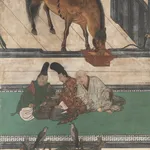
Beneath the stable unfolds an equally compelling panorama of aristocratic society. Samurai and courtiers recline upon the tatami, engaged in conversation or absorbed in games of go, shōgi and sugoroku, while monks mingle freely among them. Falconers attend to their birds, servants move quietly through the building, and grooms continue the daily routines of caring for the horses. Small dogs wander unrestrained across the composition, lending warmth and informality to the scene, while a tethered monkey, traditionally believed to protect horses from illness, provides a fascinating glimpse into the beliefs that surrounded equine care in early Japan.
One of the great achievements of these screens lies in their balance between documentary observation and decorative brilliance. The carefully ordered architecture of the stable establishes a powerful horizontal rhythm across the six panels, while the broad expanses of gold leaf are interrupted by sweeping scalloped clouds that float majestically across the upper register.
These bold abstract forms are characteristic of the Momoyama period and transform what might otherwise have been a purely descriptive scene into one of extraordinary decorative sophistication. The restrained palette of soft earth tones, greens and blacks allows the gold to shimmer with changing light, animating the entire composition.
The present screens bear a close relationship to the celebrated Horse Stable Screens in the Cleveland Museum of Art (1934.373), dated to the late Muromachi period. Both share remarkably similar stall arrangements and groups of visitors, suggesting a common pictorial tradition. Yet the present pair demonstrates the greater confidence and decorative richness associated with the Momoyama aesthetic.
The dramatic scalloped clouds, more expansive use of gold leaf, and stronger architectural geometry create a composition of greater monumentality and visual impact.
Related examples survive in the Tokyo National Museum (A-10139) and in the collection of the Imperial Household Agency, but examples of this quality and preservation are exceptionally uncommon. Indeed, the survival of an entire pair devoted exclusively to the subject of the aristocratic horse stable is itself remarkable.
Beyond their documentary importance, these screens reveal an artist of exceptional sensitivity and observational skill. Every horse possesses an individual personality; every figure contributes naturally to the rhythm of daily life. The result is not simply an image of a stable, but an eloquent meditation upon status, ceremony, discipline and the intimate relationship between man and horse at one of the most dynamic moments in Japanese history.
Beautifully preserved and possessing an important exhibition history, these screens rank among the finest surviving examples of Momoyama and early Edo genre painting, combining historical significance, artistic accomplishment and exceptional rarity in a work of remarkable visual and cultural richness.
ROLLESTON LTD
104A Kensington Church Street - London - W8 4BU
Telephone: + 44 (0) 207 229 5892
Email: advice@rollestonantiques.com
