WORKS FOR SALE


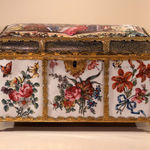
A mid 18th Century English Enamel Casket
Height: 15.0 cm
Depth: 12.2 cm
Further images
-
(View a larger image of thumbnail 1
)

-
(View a larger image of thumbnail 2
)
-
(View a larger image of thumbnail 3
)

-
(View a larger image of thumbnail 4
)

-
(View a larger image of thumbnail 5
)

-
(View a larger image of thumbnail 6
)

-
(View a larger image of thumbnail 7
)

-
(View a larger image of thumbnail 8
)

-
(View a larger image of thumbnail 9
)

-
(View a larger image of thumbnail 10
)

-
(View a larger image of thumbnail 11
)

-
(View a larger image of thumbnail 12
)

Provenance
The Hon. Mrs Nellie Ionides, recorded as no. 937 in her typescript catalogue held at the Victoria and Albert Museum.
Sotheby’s, London, 27 May 1963, lot 168, acquired by Delomosne
With Winfred Williams Ltd, acquired in New York
Christie’s, London, 13 November 2014, lot 115, property from a distinguished private collection, acquired by Aso O. Tavitian
Aso O. Tavitian Collection, Sotheby’s, New York, 9 February 2025, lot 1627
Literature
G. Bernard Hughes, English Enamels: Battersea or Bilston? Country Life, 26 May 1944
Bernard Watney, English Enamels in the 18th Century, Antiques International, 1966
Judith Crouch, York House Battersea: Finds from the Excavation of the Enamel Manufactory, Transactions of the English Ceramic Circle, 2005
Alistair Douglas et al., Elite Residence to Manufacturing Centre, PCA Monograph 22, 2019
Bernard Rackham, Porcelain as a Side Light on Battersea Enamels, Transactions of the English Porcelain Circle, 1932
Bernard Watney and R. J. Charleston, Petitions for Patents concerning Porcelain, Glass and Enamels, Transactions of the English Ceramic Circle, 1966
An English Enamel Casket: Probably Battersea, London
Circa 1752 to 1755
This remarkable enamel casket ranks among the most accomplished survivals of mid eighteenth century English enamelwork, distinguished by its unusual scale, refinement of painting and exceptional richness of ornament. In both ambition and execution it stands apart from the majority of known English enamel boxes of the period.
The casket is formed as an octagonal box, each side painted with a finely observed bouquet of flowers, some tied with fluttering ribbons, others loosely arranged and animated by butterflies and insects in flight. The painting is confident and fluid, with a delicacy of line and a sophisticated handling of colour that place it among the very finest flower painting in English enamel.
The slightly domed cover is centred with a long rectangular plaque painted after Hubert-François Gravelot’s celebrated composition A Game of Quadrille. Executed in a rich and varied enamel palette, the scene captures the elegance and sociability of fashionable London life in the 1740s. The shoulders of the casket are canted and set with eight narrow panels of gilt Chinese fretwork reserved on a deep black ground, lending the object a striking note of chinoiserie refinement and architectural clarity.
A Game of Quadrille was designed by Gravelot for Francis Hayman as part of an ambitious decorative scheme for the supper boxes at Vauxhall Gardens, one of the most fashionable pleasure grounds of mid eighteenth century London. The original painting by Hayman, dating from about 1743, is today preserved in Birmingham, while the composition was widely disseminated through an engraving by Charles Grignion. The inclusion of this subject on the present casket firmly situates it within a London cultural context, closely aligned with contemporary urban taste and entertainment.
The attribution of English enamels has long been a matter of debate. During the early twentieth century, many of the most refined examples were assigned to the short-lived York House Battersea works, established by John Brooks with the backing of Alderman Stephen Theodore Janssen and active between about 1753 and their bankruptcy in 1756. Subsequent scholarship by Bernard Rackham, Bernard Watney and Robert Charleston reassessed this position, arguing persuasively for major production centres in the Midlands, particularly Bilston and Birmingham, while restricting Battersea primarily to finely printed wares after engraved designs.
Archaeological excavations at York House, Battersea, undertaken between 1996 and 1998, have significantly altered this understanding. The discovery of enamel wasters, including examples painted with flowers and insects, alongside evidence for broader ceramic production, has confirmed that richly painted enamels were indeed produced at Battersea. Moreover, scholars have noted the close stylistic relationship between the finest Battersea flower painting and that seen at Chelsea porcelain during the early Red Anchor period of about 1752 to 1755.
In light of this evidence, the present casket can be convincingly attributed to Battersea itself. The superb quality of the flower painting, its stylistic proximity to Chelsea, and the use of a subject so closely associated with Vauxhall Gardens, located just a short distance downriver from Battersea, together support a London origin and a date in the early to mid 1750s.
ROLLESTON LTD
104A Kensington Church Street - London - W8 4BU
Telephone: + 44 (0) 207 229 5892
Email: advice@rollestonantiques.com
